Why Compact ARM Platforms Are Becoming Essential in Energy Storage Systems
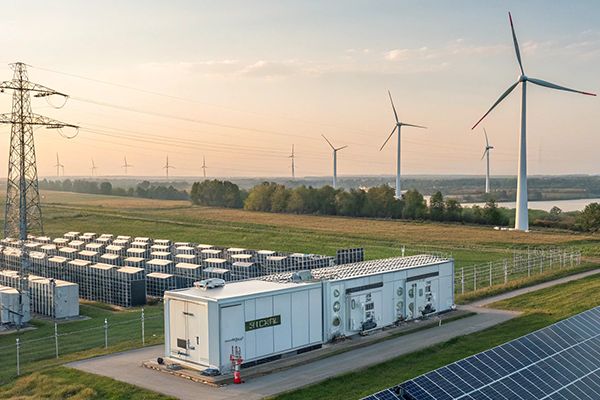
Energy storage systems are becoming one of the most important pillars of modern energy infrastructure. As renewable energy adoption accelerates worldwide, from solar farms to grid-scale battery installations, energy storage is no longer a supporting technology—it is the core mechanism that stabilizes the entire system.
But as deployments scale, the computing requirements behind these systems are quietly becoming more demanding. Not in terms of raw performance, but in terms of reliability, integration, and physical constraints at the edge.
The hidden complexity inside energy storage systems
A modern energy storage system is far more than a collection of batteries. It is a tightly coordinated environment where monitoring, control, and communication must happen continuously and locally.
Every edge system needs to manage real-time data from battery modules, track temperature and charge levels, coordinate with inverters, and communicate with external grid systems. These operations require stable edge computing capabilities that can run continuously, often in environments where human access is limited or nonexistent.
This is why edge computing has become a foundational layer in energy storage architecture. Without it, systems would rely too heavily on cloud connectivity, introducing latency and operational risk.
Why traditional industrial PCs are struggling at the edge
For years, x86-based industrial PCs have been widely used in energy and industrial control systems. They offer strong compatibility and mature support for industrial communication standards.
However, when deployed in energy storage environments, structural limitations begin to appear.
These systems often require higher power consumption, larger physical enclosures, and active cooling mechanisms. In tightly sealed battery cabinets or outdoor energy enclosures, these characteristics create challenges in both design and long-term maintenance.
Over time, these constraints translate into higher operational cost and increased system complexity—especially in large-scale deployments.
Why ARM-based platforms are gaining ground
ARM-based industrial platforms are increasingly being adopted in energy storage environments because they align more naturally with the physical and operational constraints of edge deployment.
Their advantages are not centered on raw computing power, but on efficiency and system fit. Lower power consumption reduces thermal output, making fanless designs possible. Smaller form factors allow integration into compact enclosures. And reduced heat generation improves long-term stability in sealed environments.
This combination is particularly important in energy storage systems, where hardware is expected to operate continuously for years without intervention.
Integration is the real turning point
The most important shift, however, is not simply about ARM versus x86. It is about integration.
Energy storage systems depend on a wide range of industrial communication protocols to function properly. Devices must communicate with battery management systems, sensors, controllers, and external monitoring platforms in real time.
Traditionally, this level of integration required additional expansion modules in ARM-based systems, increasing complexity and potential failure points.
Newer ARM platforms are changing this approach by integrating industrial interfaces directly into the system architecture.
Platforms such as Geniatech APC3568 combine ARM-based efficiency with built-in industrial communication support, including serial interfaces, CAN bus connectivity, GPIO control, and dual Ethernet.
The key impact is not just functionality—it is system simplification. Fewer external components mean fewer failure points and more predictable long-term operation.
Reliability becomes a design outcome, not a feature
In energy storage systems, reliability is not an optional requirement—it is the baseline expectation.
Systems often operate in sealed or semi-sealed environments where dust, humidity, and temperature fluctuations are unavoidable. In such conditions, fanless industrial design becomes more than a convenience; it becomes a necessity.
By reducing power consumption and eliminating active cooling, compact ARM platforms enable silent, low-maintenance operation that is better aligned with long-term deployment realities.
A shift driven by deployment economics
As global energy storage capacity continues to expand, deployment scale becomes just as important as technical capability.
The cost of each system is no longer defined only by hardware price, but by installation complexity, maintenance frequency, and system reliability over time.
This is where ARM-based platforms begin to reshape expectations. Their efficiency reduces operational overhead, while their compact design simplifies deployment in constrained environments.
Conclusion
Energy storage systems are evolving into intelligent, distributed infrastructure networks. As this transformation continues, the requirements placed on edge computing platforms are becoming more specific.
It is no longer enough for a system to be powerful or compatible. It must also be efficient, compact, and easy to integrate into real-world deployment environments.
Compact ARM platforms are not replacing traditional industrial computing systems. They are aligning more closely with the physical and operational realities of next-generation energy infrastructure.
And in that shift, they are becoming a foundational component of how modern energy storage systems are designed.